
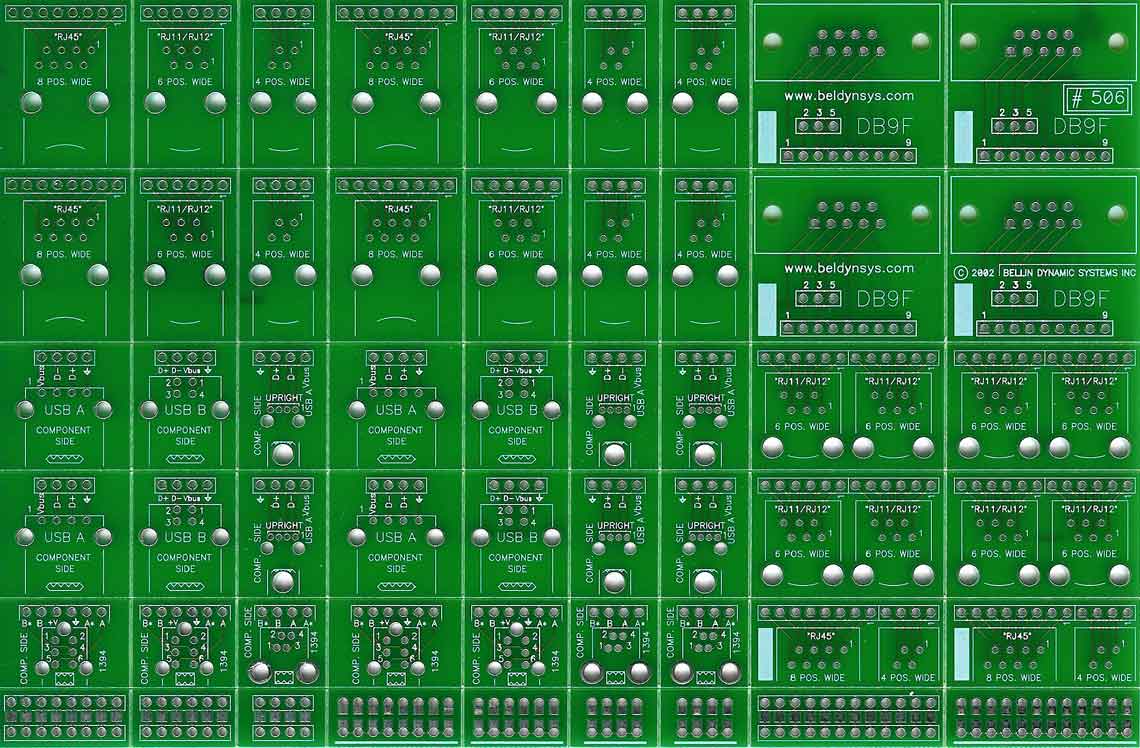

Patterns:
-
4 Position Mod. Jack, 6 Position Mod. Jack (fits RJ11
and RJ12), 8 Position Mod. Jack (Fits RJ45)
-
DB9F, DB9M (back side of DB9F), USB
A Connector, USB A Connector (Upright), USB B Connector
-
1394 4 Pin Connector, 1394 6 Pin
Connector, 805 Component Termination Pads
-
805 Component Test Pads
Compatible PCB Connectors:
| |
|
|
| Type |
Example Part
Number |
|
| |
|
|
| DB9M |
Tyco/Amp 747840-4 |
|
| DB9F |
Tyco/Amp 747844-4 |
|
| MODULAR 4
PIN |
Molex 15-43-8544 |
|
| MODULAR 6
PIN |
Molex 15-43-8566 (RJ11,
RJ12) |
|
| MODULAR 8
PIN |
Molex 15-43-8588
(RJ45) |
|
| USB A |
Molex 87531-0018 |
|
| USB A
UPRIGHT |
Molex 89485-0000 |
|
| USB B |
Molex 67068-0001 |
|
| 1394 4 PIN |
Molex 54030-0490 |
|
| 1394 6 PIN |
Molex 53460-0611 |
|
NOTE: IF YOU ARE UNFAMILIAR WITH HIGH SPEED SERIAL DATA
TRANSMISSION: Please be aware that the prototyping environment
does not meet full specifications for most high speed serial data
transfer. However, it is possible to trade range and/or
bandwidth for basic functionality in a prototyping environment.
Your data rate and range will vary according to the
characteristics of your particular setup.
Tips for the
student or novice:
1)
Shorting some leads will
likely damage your project. UNDERSTAND before wiring.
2) Keep connections short, signal pairs
close, and avoid making Y’s, even with test
leads.
3)
Keep connector-to-receptacle connections at a minimum.
4)
Learning serial communications? EIA-232 (RS-232) is a good start.
Otherwise, P506 patterns
with a ’smile’
in the silk screen may easily yield good
results with their typical applications. 'Sharp teeth’ indicate
that engineering experience or quite a bit of luck is
required. Notes for the professional
engineer: 1) Adapting to .100" spacing typically
violates impedance specifications of the wire pairs.
2) At
.100" spacing, impedance mismatch and the chance of oscillations and/or
reflections will quickly increase with circuit complexity.
Terminate properly, decouple active components thoroughly and
minimize 90 degree turns. If Y's in the signal path are required, keep all
lengths very short to keep signal reflection frequency as high
above your operating frequency as you can.
3) Working
with a network analyzer will give you a good idea of your maximum
bandwidth right away, allowing you to rapidly get a feel for what
is possible with prototyping adapters.
|